Keeping a food diary sounds like homework. Write down every chai, every biscuit, every second roti. It is also one of the habits that turns up again and again in studies of people who lose weight.
Here is what that research says, where it is weaker than it sounds, and how to make a diary useful without letting it run your life.
What the studies found
A large US trial in 2008 put 1,685 adults through a 20-week weight-loss programme. On average they lost 5.8 kg. The people who kept more food records lost more weight, and the authors found that habits like keeping a food diary and staying active explained most of the difference between people.
A 2011 review pulled together 22 studies on self-monitoring: recording food, exercise or weight. It found the same pattern every time. People who recorded more lost more. The review was also careful to call the evidence weak, because most studies could only show that the two went together, not that one caused the other.
People who are motivated to lose weight are also more likely to keep a diary. So some of the effect is the person, not the notebook. Still, a habit that shows up this consistently across so many studies is worth taking seriously.
Often beats perfect
More recent studies asked how people log, as well as whether they do.
In a 2019 online programme, researchers measured exactly how long people spent logging. In the first month it was about 23 minutes a day; by month six it had fallen to under 15. The time spent made no difference to weight loss. What did make a difference was how often people logged. Those who lost at least 5 % of their weight opened their diary about 2.4 times a day, compared with 1.6 times for those who lost less.
Two other studies point the same way. In one, keeping records helped women hold on to their loss only when they logged on more than three days a week, and how detailed the entries were made no difference. In another, people who tracked on more than two thirds of days over a year lost about 4.5 kg, while people who tracked less often lost very little.
A quick, rough entry after every meal does more than a careful, complete one once a week. Log while you still remember it.
Everyone under-counts
People are not very good at reporting what they eat.
A well-known 1992 study looked at ten people who said they could not lose weight on low-calorie diets. Measured precisely, they were eating about 47 % more than they reported and moving less than they thought. Their bodies were burning calories normally. A larger study in 2003 used the same precise method on 484 adults and found that even careful 24-hour food recalls missed around 12 to 20 % of calories, and questionnaires missed more.
Nobody in these studies was lying. It is easy to forget the ghee in the dal, the extra spoon of sugar, the namkeen at a friend's house, or to guess a bowl smaller than it was. That is one reason a weight trend is useful next to a food diary: if your log says you are eating less than you burn and the trend does not move, the log is probably missing something.
Phone or paper?
In a small 2013 trial, people asked to log with a phone app kept going far longer than people given a paper diary or a website: they recorded food on 92 days out of six months, against 29 days for paper. They also lost more weight, though the study was small and the authors said a larger trial was needed.
Another study the same year found that how often people logged, and how much weight they lost, did not differ much between phone and paper. A 2020 review of 20 studies concluded that phone-based self-monitoring led to moderate weight loss and that people stuck with it better than with paper over 6 and 12 months.
So the tool matters less than whether you keep using it. Whatever makes logging quickest for you is the right one. In BollyWeight that means a food list with Indian dishes, a barcode scanner, typing "two rotis and dal", or taking a photo of your plate and letting the AI on your phone fill in the diary. The AI food logging piece explains how that works.
Weighing yourself counts too
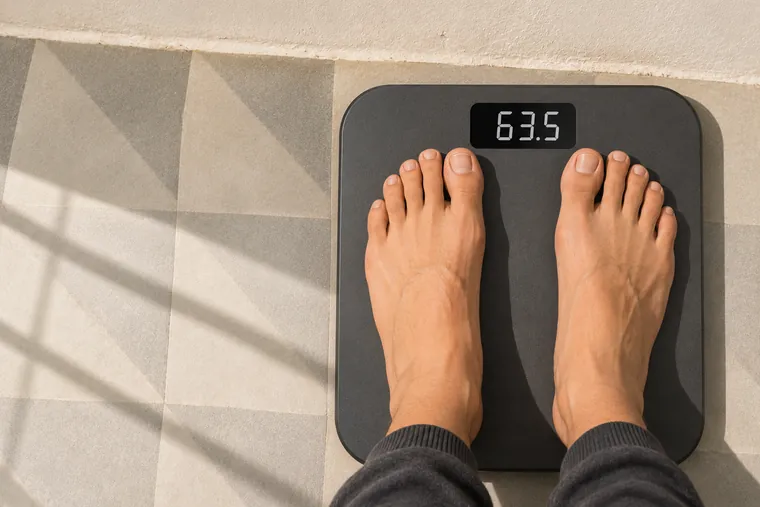
Self-monitoring is not only food. A 2015 review of 17 studies found that people who weighed themselves regularly lost more weight, and that regular weighing was not linked with more anxiety or low mood. Weight and food work well together: the diary tells you what went in, the trend tells you what it did.
When tracking is not a good idea
Food tracking is not for everyone. A 2017 survey of nearly 500 college students found that those who used calorie-tracking apps reported more worry about eating and stricter dieting habits. A 2019 survey of 122 men found that close to 40 % of those who used a calorie-tracking app felt it had contributed to eating-disorder symptoms to some degree. Both studies are surveys at one point in time, so they cannot show that the apps caused the problem. But the warning is fair.
If logging makes you anxious, if you find yourself skipping meals so you have less to record, or if you have a history of an eating disorder, stop tracking calories and talk to a doctor. Tracking only your weight, or nothing at all, is a perfectly good choice. BollyWeight is built so you can use it as a plain weight tracker and never open the food diary.
How to make a food diary work
- Log right after eating. Frequency mattered more than anything else in the studies.
- Rough is fine. "One katori dal, two rotis" is enough. Detail did not change results.
- Aim for most days, not every day. More than three days a week was where the benefit showed up.
- Remember the hidden bits. Oil, ghee, sugar in chai, and snacks between meals are where most under-counting hides.
- Watch the trend. If the log and the scale disagree for a few weeks, trust the scale.
Please consult a doctor before starting any diet or weight plan, and if tracking food ever starts to feel stressful. See our health disclaimer.
What the research says
- Hollis J.F. et al. Weight loss during the intensive intervention phase of the weight-loss maintenance trial. American Journal of Preventive Medicine, 2008. doi.org/10.1016/j.amepre.2008.04.013
- Burke L.E., Wang J., Sevick M.A. Self-monitoring in weight loss: a systematic review of the literature. Journal of the American Dietetic Association, 2011. doi.org/10.1016/j.jada.2010.10.008
- Harvey J. et al. Log often, lose more: electronic dietary self-monitoring for weight loss. Obesity, 2019. doi.org/10.1002/oby.22382
- Peterson N.D. et al. Dietary self-monitoring and long-term success with weight management. Obesity, 2014. doi.org/10.1002/oby.20807
- Ingels J.S. et al. The effect of adherence to dietary tracking on weight loss: using HLM to model weight loss over time. Journal of Diabetes Research, 2017. doi.org/10.1155/2017/6951495
- Lichtman S.W. et al. Discrepancy between self-reported and actual caloric intake and exercise in obese subjects. New England Journal of Medicine, 1992. doi.org/10.1056/NEJM199212313272701
- Subar A.F. et al. Using intake biomarkers to evaluate the extent of dietary misreporting in a large sample of adults: the OPEN study. American Journal of Epidemiology, 2003. doi.org/10.1093/aje/kwg092
- Carter M.C. et al. Adherence to a smartphone application for weight loss compared to website and paper diary: pilot randomized controlled trial. Journal of Medical Internet Research, 2013. doi.org/10.2196/jmir.2283
- Turner-McGrievy G.M. et al. Comparison of traditional versus mobile app self-monitoring of physical activity and dietary intake among overweight adults participating in an mHealth weight loss program. Journal of the American Medical Informatics Association, 2013. doi.org/10.1136/amiajnl-2012-001510
- Effect of behavioral weight management interventions using lifestyle mHealth self-monitoring on weight loss: a systematic review and meta-analysis. Nutrients, 2020. doi.org/10.3390/nu12071977
- Zheng Y. et al. Self-weighing in weight management: a systematic literature review. Obesity, 2015. doi.org/10.1002/oby.20946
- Simpson C.C., Mazzeo S.E. Calorie counting and fitness tracking technology: associations with eating disorder symptomatology. Eating Behaviors, 2017. doi.org/10.1016/j.eatbeh.2017.02.002
- Linardon J., Messer M. Calorie-tracking app use in men and eating disorder symptoms (title shortened). Eating Behaviors, 2019. doi.org/10.1016/j.eatbeh.2019.02.003