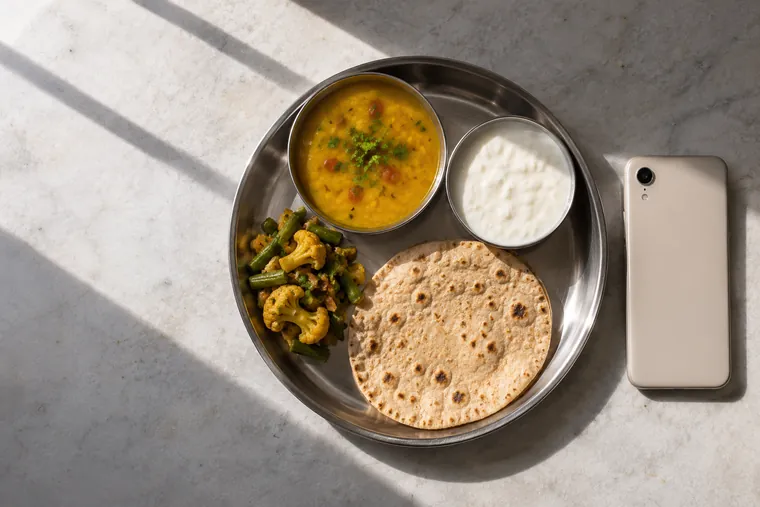
Every vegetarian has been asked where they get their protein. Usually by someone who has never checked their own.
The short answer is that a vegetarian Indian diet can give you enough protein, and many people already come close. The longer answer is that most of it tends to come from roti and rice rather than dal and dairy, which affects both protein quality and weight loss. Here are the numbers.
How much protein do you need?
India's official figure comes from the National Institute of Nutrition (ICMR-NIN), which revised it in 2020. For an adult in good health it is 0.83 g of protein per kilo of body weight per day. For a 65 kg man that is about 54 g a day; for a 55 kg woman, about 46 g. The figure is the same whether your work is light or heavy.
The same document adds a note for many Indian households: if your diet is mostly cereal and the protein is of lower quality, aim for about 1 g per kilo instead. So a 65 kg person eating mostly roti and rice with a little dal should think closer to 65 g.
These amounts are for everyday needs. While losing weight, many researchers suggest eating somewhat more, for reasons covered below.
Where it hides in an Indian kitchen
The numbers below are from the Indian Food Composition Tables (IFCT 2017), which list foods raw, and from the US food database for a few cooked foods. Cooked amounts vary with how much water goes in, so treat them as close guides.
- Dal. Raw toor dal is about 22 % protein, masoor about 20 %, urad about 23 %. A katori of cooked dal made from 30 g of raw dal gives about 6 to 7 g.
- Rajma and chana. Raw rajma is about 19 to 20 % protein. A 30 g raw portion, cooked, gives about 6 g.
- Paneer. About 19 g per 100 g. A palm-sized 100 g piece is one of the richest vegetarian sources on the plate.
- Curd. Plain whole-milk curd has about 4 g per 100 g, so a 200 g bowl gives about 7 to 8 g.
- Milk. Cow's milk has a little over 3 g per 100 g, so a 200 ml glass gives about 6.5 g. The milk in two cups of chai adds another 6 g or so.
- Soya. Raw soybean is about 36 % protein, so 30 g gives nearly 11 g. Firm tofu has about 17 g per 100 g.
- Peanuts. About 26 g per 100 g raw, so a 30 g handful gives about 8 g.
- Roti. Wheat atta is about 10.5 % protein, so a roti made from 30 g of atta gives about 3 g.
- Rice. Cooked white rice has about 2.7 g per 100 g, so a 150 g katori gives about 4 g.
A normal day, added up
Here is an ordinary vegetarian day for a 65 kg person:
- Two katoris of dal: about 13 g
- Four rotis: about 12 g
- One katori of rice: about 4 g
- 100 g of paneer in a sabzi: about 19 g
- A bowl of curd: about 7.5 g
- Milk in two cups of chai: about 6 g
That comes to about 61 g, comfortably above the 54 g target. Take out the paneer and it drops to about 42 g, below it. Paneer, curd, soya or an extra katori of dal are often what makes the difference.
Why roti with dal works better than either alone
Protein is made of building blocks called amino acids, and different foods carry them in different amounts. Cereals such as wheat and rice are low in one of them, lysine. Pulses have more lysine but less of some others. Eaten together, each fills the other's gaps.
A 2012 review of Indian diets found that nearly 60 % of the protein Indians eat comes from cereals, and that lysine is the building block most often in short supply. The 2024 Dietary Guidelines for Indians make the practical point: combining cereals with pulses in a ratio of about 3 to 1 improves the quality of the protein in a meal, and vegetarians can meet their needs with pulses, beans, peas and milk or curd. The guidelines also say most people do not need protein powders.
Dal-chawal, rajma-rice and roti-dal make a better protein together than apart. Adding curd or milk to the meal improves it further.
Among plant foods, soy and tofu score highest for protein quality, lentils and chickpeas sit in the middle, and wheat is lower. That is another reason soya and tofu are useful for vegetarians who want more protein without much more food.
Why protein matters when you are losing weight
When you eat less, your body loses some muscle along with fat. Protein helps protect the muscle.
A 2012 analysis of 24 trials with more than 1,000 adults compared higher-protein and normal-protein diets with the same calories. Over about 12 weeks, the higher-protein groups lost slightly more weight (about 0.8 kg more) and more fat, kept about 0.4 kg more lean mass, and their resting calorie burn dropped less. The authors called the benefits modest, which is fair. A 2015 review reached similar conclusions and found that higher-protein meals make people feel somewhat fuller.
Protein helps with muscle, fullness and resting calorie burn at once, even if each effect is small. If you are losing weight, getting at least your 0.83 g per kilo, and preferably a little more, is a sensible aim.
Easy ways to add protein
- Thicken the dal. A thicker dal made with more dal and less water gives more protein per katori.
- Add curd to lunch. A bowl of curd or raita adds 7 g or more.
- Use paneer, tofu or soya chunks in sabzi a few times a week.
- Snack on roasted chana or peanuts rather than biscuits or namkeen.
- Try besan. A besan chilla at breakfast brings pulse protein into a meal that is usually all cereal.
- Check your day. BollyWeight's food diary shows the day's protein next to your target, so after a few days you can see whether you are getting close.
If you have kidney disease, or a doctor has told you to limit protein, follow their advice over anything here. Please consult a doctor before starting any diet or weight plan. See our health disclaimer.
What the research says
- ICMR-National Institute of Nutrition. A brief note on nutrient requirements for Indians, the Recommended Dietary Allowances (RDA) and the Estimated Average Requirements (EAR), 2020. nin.res.in/rdabook/brief_note.pdf
- ICMR-National Institute of Nutrition. Dietary Guidelines for Indians, 2024 (booklet). nin.res.in/downloads/DGI_Booklet_English_CMYK.pdf
- Longvah T. et al. Indian Food Composition Tables 2017. ICMR-National Institute of Nutrition, Hyderabad. nin.res.in/ebooks/IFCT2017.pdf
- US Department of Agriculture. FoodData Central (cooked lentils, cooked white rice, plain whole-milk yogurt, firm tofu, raw peanuts). fdc.nal.usda.gov
- Swaminathan S., Vaz M., Kurpad A.V. Protein intakes in India. British Journal of Nutrition, 2012. doi.org/10.1017/S0007114512002413
- Rojas Conzuelo Z. et al. Protein quality changes of vegan day menus with different plant protein source compositions. Nutrients, 2022. pmc.ncbi.nlm.nih.gov/articles/PMC8912849
- Wycherley T.P. et al. Effects of energy-restricted high-protein, low-fat compared with standard-protein, low-fat diets: a meta-analysis of randomized controlled trials. American Journal of Clinical Nutrition, 2012. doi.org/10.3945/ajcn.112.044321
- Leidy H.J. et al. The role of protein in weight loss and maintenance. American Journal of Clinical Nutrition, 2015. doi.org/10.3945/ajcn.114.084038