You eat well on Sunday at a family wedding. On Monday morning the scale reads 1.2 kg more than it did on Saturday. It looks like a disaster, but it almost never is.
A body that weighs 70 kg is mostly water, and the amount of water it carries changes from day to day. So does the amount of food sitting in your stomach and gut. Both can move the scale by a kilo or more overnight, and both go back down on their own. Fat changes far more slowly.
How much fat can you gain in one day?
A kilo of body fat holds a lot of energy. The usual working figure is about 7,700 calories per kilo. That number is a rough rule: research by Kevin Hall at the US National Institutes of Health showed it fits people carrying a lot of fat better than leaner people, and that real weight change is never pure fat. But it is close enough to answer the question.
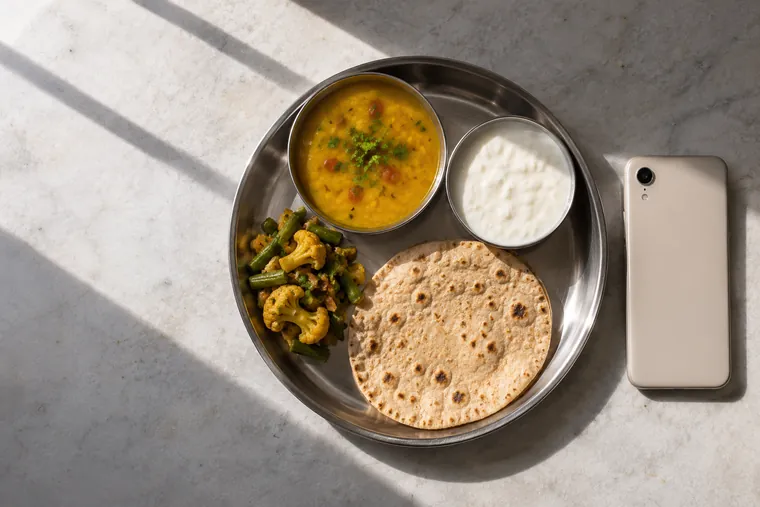
To gain 1.2 kg of actual fat in a day you would need to eat about 9,000 calories more than your body used. For most adults that is four or five days of food, on top of a normal day. A big plate of biryani, two sweets and a second helping of paneer might add 1,500 to 2,000 calories. That is roughly 0.2 to 0.25 kg of fat, if every extra calorie were stored. The rest of the jump on the scale is something else.
Carbohydrate brings water with it
Your body stores some carbohydrate in the liver and muscles as glycogen, a kind of starch your body keeps ready for quick energy. Glycogen does not sit there dry. A study of muscle in trained men found that every gram of glycogen is stored with at least 3 grams of water.
So after a day of rice, rotis, naan and mithai, your stores fill up, and the water comes in with them. This is how the body keeps fuel on hand. When you go back to normal meals, the stores settle and the water goes too.
This also works the other way. It is why the first week of a strict low-carbohydrate diet often shows a big drop on the scale. Much of that early loss is glycogen and its water, not fat, and it tends to come back as soon as normal meals return.
Salt: real, but smaller than people think
Restaurant and wedding food is usually salty. The World Health Organization advises adults to eat less than 5 g of salt a day. A review of Indian studies found the average intake here is about 11 g a day, more than double that, and a heavy meal pushes it higher.
Salt makes you thirsty, and you drink more. The common claim is that a salty day makes you "hold" kilos of water. The research is less dramatic than that. One controlled study in Germany found that men on a high-salt diet did not gain total body water or body weight in the way the old theory expected. Some fluid moved around inside the body instead. So salt can play a part in a jump the morning after, together with extra drinks and extra food, but it is rarely the whole story on its own.
Food still on its way through
A litre of water or chai weighs about a kilo. A full dinner can weigh close to a kilo too. Until it is digested and passed, it is on the scale with you. A late dinner, a slow gut, travel or a change in routine can all leave more in transit the next morning.
Weekends and festivals leave a pattern
Large studies of people who weigh themselves every day show the same shape again and again. Weight rises over the weekend and falls during the week. In one European study of more than 1,400 people, Monday's weight was about 0.2 to 0.3 % above the weekly trend, then dropped back by midweek. The same study found Christmas left people about 1.35 % heavier on average, and not all of it came off afterwards.
An older study from the US National Institutes of Health followed 195 adults through the winter holidays. They gained an average of 0.37 kg over the holiday weeks. That is much less than most people believe they gain, but a lot of it stayed. Diwali, Navratri and wedding season are not in these studies, though the pattern is likely to look similar.
One heavy day mostly shows up as water and food. A long run of heavy days is what moves fat.
Periods and fluid
Many women notice the scale goes up just before or at the start of a period, and feel bloated. A long study of women's health found that self-reported bloating peaked on the first day of the period. Hormone changes over the cycle affect how much fluid the body keeps. The extra usually goes within a few days after the period starts. If you track your weight through the month, compare the same point in each cycle rather than one week with the next.
How to read your weight without panic
- Weigh at the same time. First thing in the morning, after the bathroom, before food or drink, in similar clothes. That removes some of the noise.
- Look at the trend, not the day. A single reading is one frame of a film. A week of readings shows where the story is going. BollyWeight draws a trend line through your weigh-ins for exactly this reason; the trend line piece explains how.
- Give a jump three or four days. If it came from water and food, it usually fades by then. If it stays for weeks, it is real change, and worth a look at your meals.
- Do not cut hard the next day. Skipping meals to "undo" one dinner tends to lead to another big meal. Go back to your normal day.
When a jump is worth asking about
Sudden weight gain with swelling in the legs or ankles, shortness of breath, or gain that keeps climbing without any change in what you eat can have medical causes, including heart, kidney and thyroid problems or some medicines. Those are not things a weight app can judge. Please consult a doctor if you notice them. See our health disclaimer.
What the research says
- Turicchi J. et al. Weekly, seasonal and holiday body weight fluctuation patterns among individuals engaged in a European multi-centre behavioural weight loss maintenance intervention. PLoS ONE, 2020. doi.org/10.1371/journal.pone.0232152
- Hall K.D. What is the required energy deficit per unit weight loss? International Journal of Obesity, 2008. doi.org/10.1038/sj.ijo.0803720
- Fernández-Elías V.E. et al. Relationship between muscle water and glycogen recovery after prolonged exercise in the heat in humans. European Journal of Applied Physiology, 2015. doi.org/10.1007/s00421-015-3175-z
- Heer M. et al. High dietary sodium chloride consumption may not induce body fluid retention in humans. American Journal of Physiology: Renal Physiology, 2000. pubmed.ncbi.nlm.nih.gov/10751219
- World Health Organization. Salt reduction, fact sheet. who.int/news-room/fact-sheets/detail/salt-reduction
- Johnson C. et al. Mean population salt consumption in India: a systematic review. Journal of Hypertension, 2017. pubmed.ncbi.nlm.nih.gov/27755388
- Yanovski J.A. et al. A prospective study of holiday weight gain. New England Journal of Medicine, 2000. pubmed.ncbi.nlm.nih.gov/10727591
- Study of Women's Health Across the Nation: fluid retention over the menstrual cycle, 12-month data. 2011. pmc.ncbi.nlm.nih.gov/articles/PMC3154522